Bradenton Real Estate
IMG Academy
Bradenton
.jpg?width=48&height=48&name=Profile%20Pic%20Cropped%20(1).jpg)
Industrial real estate is often discussed as though it were one market.
It isn't.
A 300,000-square-foot distribution center and a 5,000-square-foot warehouse occupied by an electrical contractor may both fall under the broad category of “industrial,” but the businesses using them, the supply of available space and the forces driving their performance can be very different.
That distinction is becoming particularly important along Florida's Gulf Coast.
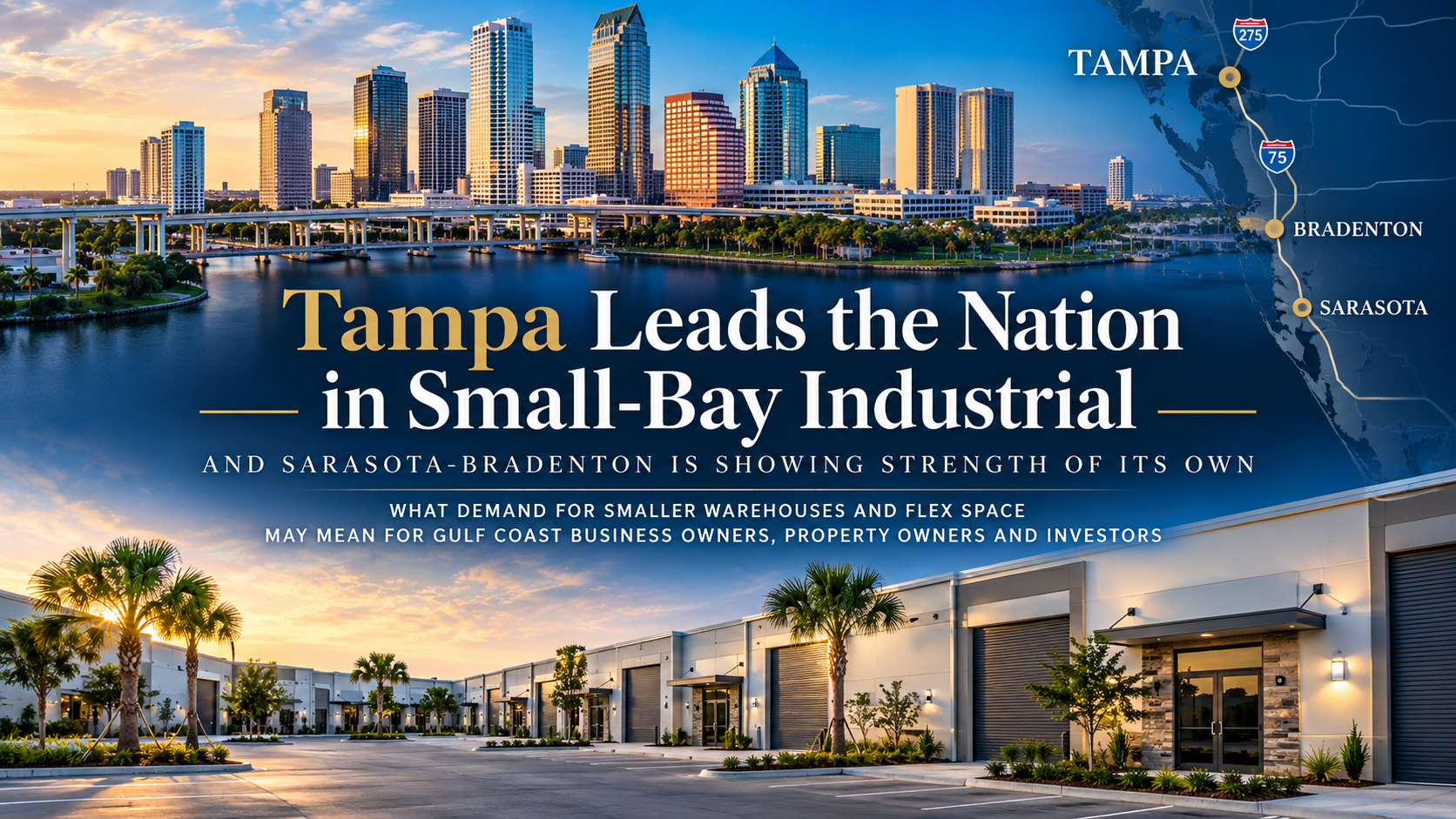
In September 2026, CoStar ranked Tampa first among the 54 largest U.S. markets for small-bay industrial performance, with Tampa ranking first for rent growth and third for growth in leasing activity.
But the more interesting story may extend beyond Tampa.
Recent research and transactions suggest that smaller industrial properties are also attracting meaningful tenant and investor interest farther south through Manatee County and Sarasota — creating an industrial story that stretches across a much larger portion of Florida's Gulf Coast.
There is no single building size that defines every small-bay industrial property.
For its national ranking, CoStar examined several measures involving smaller industrial buildings and spaces, including leasing activity for spaces below 50,000 square feet, vacancy trends among properties between 10,000 and 100,000 square feet, inventory growth among buildings of 100,000 square feet or less, and rent growth.
In practice, the category includes many of the smaller warehouse, flex and light-industrial spaces used every day by local and regional businesses.
Typical occupants can include:
These aren't necessarily companies looking for enormous regional distribution centers.
Many simply need functional space with appropriate loading access, enough room for equipment or inventory and convenient access to the customers and communities they serve.
That difference matters.
CoStar's September 2026 analysis found that Tampa's small-bay leasing activity remains substantially above pre-pandemic levels.
The firm attributed demand to construction, manufacturing, logistics and service-oriented businesses while also noting that relatively limited amounts of new small-bay inventory have been added compared with many competing Sun Belt markets.
At the same time, demand for large speculative industrial facilities has cooled.
That has produced an increasingly important split within Tampa's industrial market.
Institutional Property Advisors reported earlier this year that vacancy among Tampa industrial buildings larger than 100,000 square feet had reached approximately 12% in March, compared with roughly 4% for small-bay properties.
CBRE has observed a similar divide. While Tampa's overall industrial vacancy increased as the market absorbed recent construction, the firm reported that infill locations and buildings below 100,000 square feet remained among the most constrained portions of the market.
In other words, a headline about rising industrial vacancy doesn't necessarily describe what an owner of a smaller warehouse is experiencing.
Building size, location and functionality increasingly matter.
The connection to Sarasota and Bradenton is what makes this particularly interesting for Gulf Coast property owners.
Institutional Property Advisors' 2026 industrial outlook identified Sarasota-Bradenton as one of the faster-growing areas experiencing historically high small-bay demand.
The report also found that Sarasota-Bradenton posted record industrial sales activity, with buyers particularly active along U.S. 301 between Manatee and Sarasota counties.
That corridor deserves attention.
U.S. 301 connects established industrial areas, growing residential populations and important transportation routes through both counties. Industrial properties along and near the corridor can serve businesses operating throughout Sarasota, Bradenton, Lakewood Ranch, Palmetto and the larger Gulf Coast region.
And recent transactions provide tangible evidence of investor interest.
On September 24 — the same day CoStar announced Tampa's No. 1 national small-bay ranking — a two-property small-bay industrial portfolio in Bradenton and Palmetto sold for $26 million.
The Suncoast Small Bay Industrial portfolio totals approximately 161,570 square feet.
A single transaction doesn't establish the direction of an entire market.
But a significant investment in smaller industrial properties in Manatee County, occurring alongside broader evidence of strong small-bay demand throughout the region, is noteworthy.
It also illustrates why Manatee County shouldn't simply be treated as the space between Tampa and Sarasota.
Bradenton and the surrounding Manatee market occupy an increasingly important position within the Gulf Coast economy, with access to I-75, U.S. 301 and major employment and population centers to both the north and south.
The evidence continues into Sarasota.
In September, The Silverman Group acquired Porter Commerce Park, a three-building small-bay industrial portfolio totaling approximately 59,000 square feet near the I-75 and Fruitville Road interchange.
The property was fully leased to 12 tenants occupying spaces ranging from approximately 2,500 to 12,500 square feet.
Those tenants include the kinds of businesses at the center of the small-bay story: service providers, specialty trades, light manufacturers and regional distributors.
The acquisition followed Silverman's purchase in 2025 of Sarasota's Airport Commerce Center near Sarasota-Bradenton International Airport.
That property consists of eight buildings totaling approximately 186,675 square feet and was fully leased to 48 tenants when the transaction was announced.
Cushman & Wakefield reported at the time that Sarasota's small-bay industrial market had generated approximately 670,000 square feet of direct net absorption over the preceding five years, while rental rates had increased 81% during that period.
Those numbers help explain why investors are paying attention.
This does not mean every industrial property in Sarasota is experiencing the same conditions.
That's an important distinction.
Integra Realty Resources reported in its August 2026 Sarasota industrial analysis that vacancy had risen from historically low levels as speculative development delivered faster than tenants absorbed new space.
But the firm highlighted an important issue: much of that new supply includes larger big-box distribution product.
Its analysts specifically cautioned that market-wide statistics can conceal significantly different conditions between big-box and small-bay industrial properties.
That's remarkably similar to what we're seeing in Tampa.
A market can simultaneously have increasing overall industrial vacancy and strong demand for certain smaller, well-located properties.
For an owner, buyer or investor, simply asking “What's the industrial vacancy rate?” may therefore be the wrong question.
A better question may be:
What's happening with properties like mine, in my size range, in my specific location?
Several structural characteristics help explain the resilience of smaller industrial properties.
First, the tenant base is often tied closely to the local economy.
An HVAC company serving homeowners in Bradenton doesn't necessarily move its operation to another state because warehouse conditions change nationally. Neither does a Sarasota electrical contractor, pool company, specialty manufacturer or local distributor.
Those businesses need to remain reasonably close to employees, suppliers and customers.
Second, desirable infill industrial land can be difficult to replace.
As Gulf Coast communities grow, land faces competing demand from residential, retail, mixed-use and other development. Building new small industrial properties in established locations isn't always easy or economically attractive.
Third, smaller spaces serve a broad range of businesses.
That creates a different demand profile from very large distribution centers, where the tenant pool is smaller and a single vacancy can place hundreds of thousands of square feet back onto the market.
None of that makes small-bay industrial immune to economic cycles.
It does, however, help explain why its fundamentals can diverge from the broader industrial market.
Manatee County occupies an especially interesting position in this story.
To the north sits the much larger Tampa Bay industrial economy.
To the south sits Sarasota's growing population and constrained industrial market.
Between them are Bradenton, Palmetto, I-75, U.S. 301 and the broader north Manatee industrial area, including SeaPort Manatee.
That geography creates opportunities for several very different types of industrial real estate.
Small contractor and service bays may serve local businesses and population growth, while larger warehouse and logistics properties can benefit from highway and port access.
Those property types should not automatically be analyzed the same way.
For property owners, understanding where a building fits within that spectrum can be just as important as understanding the broader market.
For someone who already owns a smaller warehouse or flex property in Tampa Bay, Bradenton or Sarasota, the current environment raises several questions.
How does the property's rent compare with today's market?
How difficult would the space be to replace?
What types of tenants are actively seeking that size and configuration?
Would an investor value the property differently if it were occupied by several smaller tenants rather than one large user?
And perhaps most importantly:
Has the property's value changed more than the owner realizes?
A longtime owner may have purchased an industrial building years before today's population growth, rent increases and scarcity of well-located small-bay space.
That doesn't automatically mean selling is the right decision.
It does mean understanding the property's current position may be worthwhile.
There's another group that should be watching this market closely: businesses occupying industrial space.
For a growing contractor, manufacturer, distributor or service business, the decision between leasing and owning real estate can have long-term consequences.
An owner-occupied industrial property can become more than a place to operate.
Over time, the real estate itself may become a significant business asset.
That creates questions extending beyond a traditional lease-versus-buy calculation.
Should the business and real estate be owned separately?
What happens to the building when the owner eventually sells the company?
Could the business be sold while the owner retains the real estate and becomes the landlord?
Would selling both together produce a better outcome?
Those decisions depend heavily on the individual business, property, financing and owner's long-term objectives.
But they're worth considering well before a transition or sale becomes urgent.
For investors, the recent numbers are compelling — but discipline still matters.
“Small-bay” alone does not make a property a good investment.
Important considerations include:
A fully occupied industrial property can still carry risk if leases expire simultaneously or rents aren't sustainable.
Likewise, an older building with vacancy may represent either a problem or an opportunity depending on location, configuration and the cost required to reposition it.
The details matter.
The most important takeaway may be that Florida's Gulf Coast industrial market cannot be understood through a single vacancy number or headline.
Tampa's No. 1 national ranking highlights the strength of small-bay industrial properties.
Sarasota-Bradenton's historically strong demand, record sales activity and recent transactions suggest that the underlying story extends farther south.
At the same time, rising vacancy in portions of the broader industrial market reminds us not to treat every warehouse the same.
From Tampa through Manatee County and into Sarasota, smaller industrial buildings serving contractors, manufacturers, distributors and local service businesses occupy a distinct part of the commercial real estate landscape.
For owners and investors, that distinction is becoming increasingly important.
And for business owners, the building they operate from may deserve to be viewed not simply as overhead — but as part of a much larger real estate and long-term business strategy.
If you own, lease or are considering acquiring commercial property in Sarasota, Manatee County or the greater Tampa Bay region, understanding the specific property, submarket and ownership objective matters more than relying on broad market averages.
I work with property owners, investors and business owners to evaluate real estate within the context of the larger decision — whether that involves a sale, acquisition, investment property, owner-occupied building or a future business and property transition.
John Acosta
Real Estate Advisor
Sarasota • Manatee • Tampa Bay
Residential • Commercial • Investment • Business & Property Transitions
CoStar Group — Tampa, Columbus Lead CoStar's Small-Bay Industrial Performance Ranking
CoStar's September 24, 2026 national analysis ranking Tampa first among 54 major U.S. markets for small-bay industrial performance and explaining its methodology.
Institutional Property Advisors — 2026 National Industrial Investment Midyear Outlook
National and regional industrial analysis addressing Tampa small-bay vacancy, Sarasota-Bradenton demand and investment activity along U.S. 301.
CBRE — Tampa Industrial Figures, Q1 2026
Tampa industrial-market analysis examining vacancy, new supply and differences in conditions by building size and location.
Integra Realty Resources — 2026 Mid-Year Viewpoint: Sarasota Industrial Report
Analysis of Sarasota industrial supply, vacancy and the growing divergence between larger distribution facilities and small-bay properties.
Cushman & Wakefield — Sale of Airport Commerce Center, Sarasota
Transaction and market information concerning the eight-building Sarasota small-bay industrial property near Sarasota-Bradenton International Airport.
Real Estate NJ — Silverman Group Expands Sarasota Holdings with 59,000-Square-Foot Small-Bay Portfolio
September 2026 reporting on the acquisition of Porter Commerce Park and the tenant profile of Sarasota small-bay industrial space.
Tampa Bay Business Journal — Manatee County Small-Bay Industrial Portfolio Sale
September 2026 reporting on the $26 million sale of small-bay industrial properties in Bradenton and Palmetto.
Market statistics and transaction information are based on the cited sources and reflect conditions reported at the time of publication. Commercial real estate conditions can change, and individual properties should be evaluated based on their specific characteristics.