

Ballet Training in Sarasota
Sarasota Ballet School
Dance Education
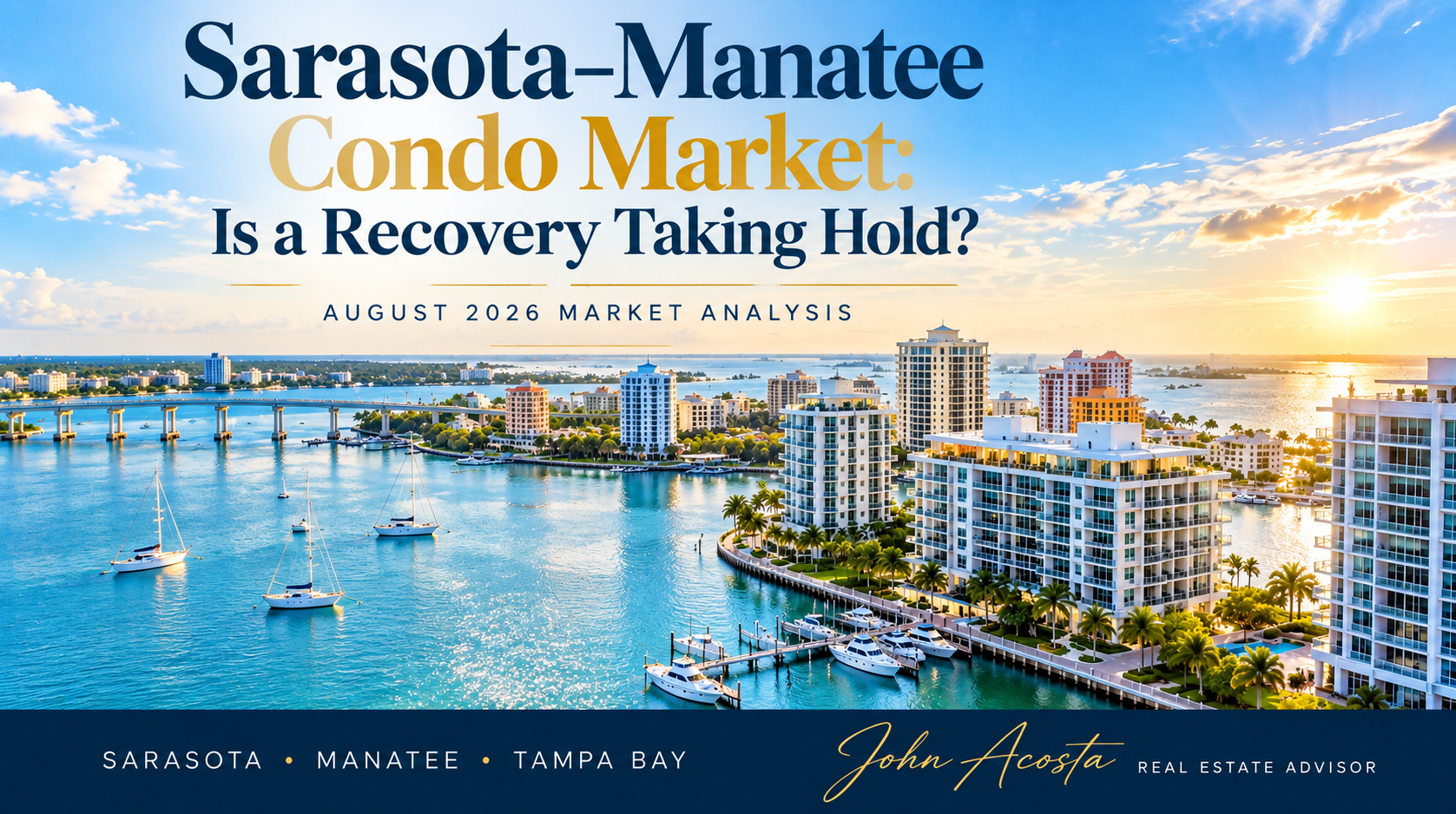

Something important is changing in the Sarasota and Manatee County housing markets.
It is not a return to the frenzy of several years ago. It is not a sudden surge in prices. And it certainly does not mean every property—or every condominium building—is experiencing the same market.
But the latest numbers show a market that is becoming more active while available inventory is tightening.
The change is particularly noticeable in condominiums and townhouses.
According to the REALTOR® Association of Sarasota and Manatee's August 2026 market report, closed and pending sales increased across all four major residential segments in Sarasota and Manatee counties. Active inventory and months of supply declined across all four as well.
The strongest year-over-year sales gains came from condos and townhouses.
That deserves attention.
Across the combined North Port–Sarasota–Bradenton metropolitan area, 1,333 single-family homes closed during August, a 3.3% increase from a year earlier.
Condo and townhouse sales increased considerably faster.
There were 522 condo and townhouse closings, up 16.8% year over year.
The combined condo median sale price was $309,225, up 4.1%, while the median time to contract declined to 79 days.
Those numbers alone do not establish a full housing recovery.
They do, however, show something arguably more important at this stage of the cycle: transactions are happening again.
Buyers and sellers appear to be finding prices at which they are willing to transact, and inventory that accumulated during the market slowdown is beginning to decline.
Sarasota County's single-family market remains considerably tighter than its condo market.
There were 646 single-family closings in August, up a modest 0.8% from August 2025.
The median sale price slipped 1.1% to $470,000.
At the same time, active single-family inventory fell 20.8% to 2,619 homes, leaving just 3.7 months of supply.
Homes reached contract in a median of 47 days.
Perhaps more revealing is what sellers actually received. The median sale represented 94.7% of the property's original asking price, compared with 92.3% a year earlier.
In other words, Sarasota's single-family market is not showing dramatic price appreciation, but the balance between buyers and sellers appears to be tightening.
Sarasota County's condo and townhouse numbers tell a different story.
Closed sales increased 13.8% year over year to 281 transactions.
The median sale price increased 3.3% to $310,000, while active inventory declined 11.8% to 1,659 units.
Months of supply fell to 5.2.
That remains substantially more inventory than Sarasota's single-family market, but it is a meaningful change in direction.
Sellers also received a median 91.6% of their original asking price, compared with 88.5% a year earlier.
That difference matters.
It suggests that the gap between what sellers initially want and what buyers are ultimately willing to pay has been narrowing.
Still, Sarasota condos spent a median 83 days on the market before reaching contract—far longer than the 47 days recorded for single-family homes.
So this is not a market in which every condo suddenly sells easily.
It is a market in which more condos are selling.
That distinction is critical.
Manatee County posted stronger year-over-year gains in both major property categories.
Single-family closed sales increased 5.7% to 687 transactions.
The median sale price rose 5.9% to $495,000.
Active inventory declined 7.0% to 2,616 homes, producing 3.9 months of supply.
The median time to contract was 45 days, while sellers received 95.6% of their original asking price.
The contrast with Sarasota is worth noting.
Sarasota's single-family median price was slightly lower than a year earlier even as inventory contracted sharply. Manatee's median price increased while sales and inventory moved in directions that also favored a tighter market.
This is one reason broad statements about "the Sarasota–Manatee market" can be misleading.
Even neighboring counties can be moving differently.
The most striking August number may have come from Manatee County condos and townhouses.
Closed sales increased 20.5% year over year to 241 transactions.
The median sale price rose 5.4% to $307,000.
Meanwhile, active inventory declined 16.1% to 1,171 units and months of supply fell to 4.9.
Properties reached contract in a median 72 days.
Sellers received 93.4% of their original asking price, compared with 90.4% a year earlier.
Again, none of those figures means every Manatee condo has suddenly become easy to sell.
But rising transaction volume combined with declining inventory is considerably more significant than a price increase by itself.
I think the most useful answer is: there are increasingly clear signs of one, but we need to define what is recovering.
The strongest evidence is not simply that median condo prices increased in August.
It is that more properties are trading.
Sarasota condo and townhouse closings increased 13.8%.
Manatee increased 20.5%.
Across the two-county metropolitan market, condo and townhouse closings increased 16.8%.
Pending activity also strengthened, inventory declined, months of supply tightened and properties generally moved through the market faster.
Florida Realtors has identified a similar adjustment at the statewide level. Condo and townhouse buyers have been returning across multiple price ranges as the market adapts to the regulatory, reserve, assessment and insurance changes that have affected Florida condominiums in recent years.
That is what I would call a recovery in market function and transaction activity.
It is not the same thing as saying condo values have universally recovered.
And it certainly does not eliminate the financial issues affecting individual condominium associations.
This may be the most important point for anyone considering a Florida condominium.
Two units can have similar square footage, views, finishes and asking prices—and represent very different financial propositions.
Florida's condominium reforms have increased scrutiny of the physical and financial condition of many older condominium buildings.
Qualifying residential condominium buildings three habitable stories or higher are subject to structural integrity reserve study requirements, and aging buildings may also be subject to milestone structural inspections.
Those studies can identify future repair and replacement obligations involving major components such as roofs, structural systems, plumbing, electrical systems, waterproofing, windows and exterior doors.
If an association's existing reserves are insufficient to meet its required funding schedule, the financial consequences do not disappear.
They can ultimately show up through increased regular assessments, special assessments, association borrowing or some combination of those approaches.
That makes condominium due diligence increasingly important.
The question is no longer simply:
"Do I like this condo?"
It should also be:
"What am I buying into?"
A buyer evaluating a condominium should look beyond the unit itself.
Association budgets, reserve funding, the most recent Structural Integrity Reserve Study when applicable, milestone inspection reports, insurance information, pending or recently completed capital projects, current assessments, proposed assessments and association meeting records can all materially affect the economics of ownership.
Monthly fees also deserve context.
A higher association fee is not automatically evidence of a poorly managed property. In some circumstances, stronger reserve contributions or appropriate insurance coverage may result in higher current expenses while reducing exposure to deferred obligations.
Likewise, an unusually low fee is not automatically a bargain.
The financial health of the association matters.
This is increasingly a building-by-building market.
The August numbers also provide an interesting message for buyers.
Sarasota condo sellers received a median 91.6% of their original asking price.
Manatee condo sellers received 93.4%.
Those figures tell us that negotiation has hardly disappeared.
But both were higher than a year earlier.
At the same time, condo inventory is declining.
That means buyers may still have meaningful negotiating opportunities, particularly on properties that have been listed for an extended period or face association-related financial issues.
What buyers should not assume is that conditions will remain static simply because condos were difficult to sell during the previous phase of the market.
The data are changing.
For condo sellers, improving transaction volume is encouraging.
It does not eliminate the need to price intelligently.
Buyers are comparing more than units. They are comparing buildings, association finances, fees, assessments, insurance exposure, reserve positions and anticipated capital needs.
A well-maintained unit in a financially troubled association can still encounter resistance.
Conversely, a property in an association with clear financial planning, completed inspections and understandable future obligations may have an important competitive advantage.
Presentation matters.
Pricing matters.
But increasingly, documentation matters too.
The shift is also important for investors, landlords and absentee owners.
A market with improving transaction volume can create opportunities that are not immediately obvious from median-price statistics.
Owners who postponed selling during a period of heavy inventory may want to reassess their position as competing supply declines.
Investors considering acquisitions should evaluate the entire ownership cost—not simply purchase price and potential rent.
Association fees, assessments, insurance exposure, rental restrictions, reserve funding and future capital projects can materially alter investment returns.
For an absentee owner, there is another consideration: condominium conditions can change while the owner is hundreds or thousands of miles away.
Association budgets, inspection results, reserve requirements and proposed assessments deserve active attention.
One of the clearest lessons from August is that Sarasota and Manatee should not be treated as interchangeable.
Sarasota single-family inventory fell sharply while its median price declined slightly.
Manatee single-family prices and closed sales both increased.
Sarasota's condo market recorded meaningful improvement, but Manatee's condo market posted an even larger year-over-year increase in closed sales.
Then within each county are entirely different submarkets.
Downtown Sarasota is not Siesta Key.
Longboat Key is not Palmer Ranch.
Anna Maria Island is not Lakewood Ranch.
Northwest Bradenton is not eastern Manatee County.
And one condominium building can have a dramatically different financial profile from the building next door.
County-level statistics are useful for identifying direction.
Property-level decisions require going deeper.
The August numbers make the next several monthly reports particularly important.
I will be watching whether condo and townhouse pending sales continue to translate into closings, whether inventory continues declining, whether months of supply tightens further and whether sellers continue capturing a larger percentage of their original asking prices.
I will also be watching whether the improvement spreads consistently across price ranges and communities.
If those trends persist, the case for a broader condo-market recovery becomes considerably stronger.
For now, the evidence points to a market that is functioning better, moving faster and absorbing inventory.
That is meaningful.
But in today's Sarasota–Manatee condominium market, the headline numbers are only the beginning of the analysis.
The property matters.
The building matters.
The association matters.
And increasingly, understanding the difference between them is where good real-estate decisions begin.
REALTOR® Association of Sarasota and Manatee — August 2026 Real Estate Market Report
Local August 2026 single-family, condominium and townhouse sales, pricing, inventory, supply and marketing-time statistics for Sarasota and Manatee counties.
REALTOR® Association of Sarasota and Manatee — Market Statistics
Current and historical residential market reports using Florida Realtors® data compiled from Stellar MLS.
Florida Realtors® — August 2026 Florida Housing Market Data
Statewide residential sales, pricing, inventory and pending-sales data.
Florida Realtors® — Florida Condo Sales Strengthen Across Price Ranges
Analysis of improving Florida condo and townhouse activity and the market's adjustment to regulatory, assessment and insurance changes.
Florida Department of Business and Professional Regulation — Condominium Information & Resources
Official information concerning Structural Integrity Reserve Studies, milestone inspections, reserve requirements and condominium compliance.
Florida Statutes — Chapter 718, Condominium Act
Current Florida statutory provisions governing condominiums, including reserve and association requirements.
Florida Statutes — Section 553.899, Mandatory Structural Inspections
Current statutory requirements concerning milestone inspections for qualifying condominium and cooperative buildings.