
John Acosta
Sarasota Real Estate
New Construction
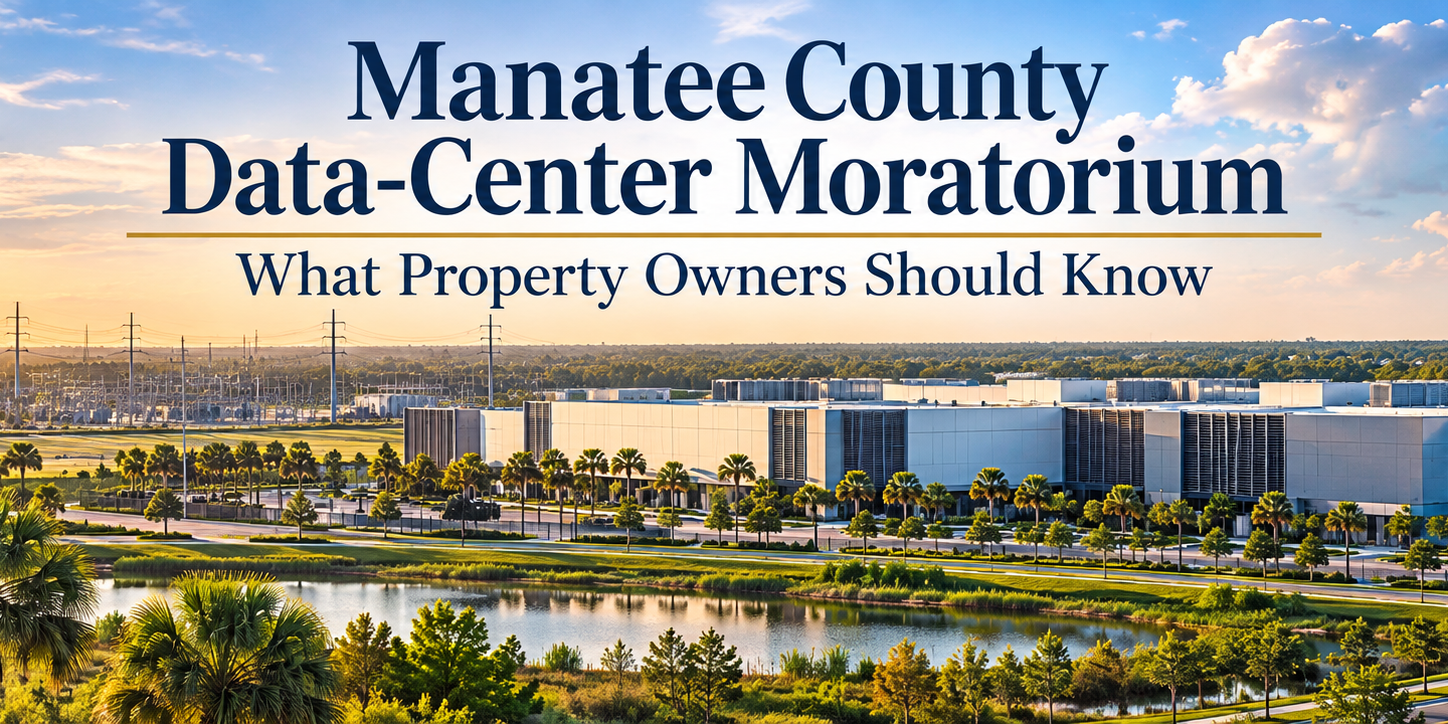

Manatee County commissioners are preparing to consider a temporary pause on one of the fastest-growing—and increasingly infrastructure-intensive—forms of development in the country.
On Tuesday, October 6, 2026, the Manatee County Board of County Commissioners is scheduled to hold the second required public hearing on Ordinance 26-42, a proposal that would establish a temporary 12-month moratorium involving new data centers, large-scale data centers and other large-load customers in unincorporated Manatee County. The hearing is scheduled to begin at 9:00 a.m. at the Manatee County Administrative Center in downtown Bradenton.
The proposal is significant, but the word moratorium can easily create the wrong impression.
Manatee County is not considering a permanent ban on data centers.
Instead, the County is considering a temporary planning pause intended to give staff time to evaluate whether its Comprehensive Plan, Land Development Code and other regulations adequately address facilities that can place unusually large demands on electricity, water and other infrastructure—and that can raise land-use questions involving location, noise, buffering and compatibility with surrounding properties.
For homeowners, property owners, landowners, developers and investors, that distinction matters.
This is ultimately not just a technology story. It is a land-use, infrastructure and real-estate story.
As of October 5, 2026, Ordinance 26-42 remains a proposal ahead of the October 6 public hearing and consideration of adoption.
According to Manatee County's official public notice, Ordinance 26-42 would establish a temporary moratorium on the submission and acceptance of certain applications involving data centers, large-scale data centers and other large-load customers within unincorporated Manatee County.
The covered applications identified by the County include:
That geographic distinction—unincorporated Manatee County—is important. This is a County land-use action within the County's jurisdiction. It should not be read as automatically imposing an identical rule inside every incorporated municipality simply because that municipality is geographically within Manatee County.
The Board held the first of two required public hearings on September 22. The second hearing and consideration of adoption is scheduled for October 6.
A temporary moratorium is therefore best understood as a planning pause, not a permanent prohibition.
County officials say the proposed pause would provide time to research and develop potential amendments to the Comprehensive Plan, Land Development Code and other applicable regulations.
Among the issues identified by Manatee County are water demand, electrical demand, appropriate locations, noise, buffering and compatibility with surrounding uses.
Those subjects illustrate why this issue extends well beyond computers and servers.
A land use can be technically possible on a particular property while its scale, infrastructure requirements and relationship to neighboring properties still require additional planning.
For Manatee County, the question is therefore not simply whether data centers should exist.
The more consequential question is:
If large data centers come to Manatee County, where should they go, what infrastructure should support them, and what standards should govern their relationship with surrounding properties?
At its simplest, a data center is a facility containing computing equipment used to process, store and transmit digital information.
The servers housed inside data centers support much of the digital infrastructure people and businesses use every day: cloud computing, websites, streaming services, financial transactions, business applications, communications, artificial intelligence and countless other online services.
Not every data center is enormous.
The largest facilities, however, can consume electricity on an entirely different scale from a conventional office building or warehouse.
Florida's 2026 legislation addresses particularly large users through the concept of a large-load customer, using an anticipated monthly peak electrical load of 50 megawatts or more at a single location under the statutory criteria. Florida law also addresses large-scale data centers using that threshold.
That scale helps explain why governments and utilities increasingly distinguish the largest computing facilities from ordinary commercial development.
Two buildings may occupy similar amounts of land while having dramatically different infrastructure requirements.
Data centers themselves are not new.
What is changing is the scale and speed of demand.
Cloud computing had already fueled major investment in large computing facilities. The rapid expansion of artificial intelligence is adding another layer because training and operating advanced AI systems can require enormous amounts of computing capacity.
The U.S. Department of Energy's Lawrence Berkeley National Laboratory estimated in its June 2026 update that data centers could account for approximately 11.8% of total U.S. electricity consumption by 2030.
Because forecasting a rapidly evolving industry is difficult, the laboratory modeled a range rather than presenting one outcome as certain. Its scenarios ranged from approximately 9.5% to 15.3% of U.S. electricity consumption by 2030.
The U.S. Energy Information Administration has also identified data-center development as one contributor to growing commercial and industrial electricity demand.
That does not mean every proposed data center threatens a local electrical grid.
It does mean utilities, regulators and local governments increasingly need to understand how exceptionally large new electrical loads fit into long-term infrastructure planning.
Servers generate heat continuously.
Keeping thousands of pieces of computing equipment within safe operating temperatures requires substantial cooling infrastructure.
Some data centers use evaporative or other water-dependent cooling systems. Others rely more heavily on closed-loop systems, air cooling, dry cooling or combinations of technologies.
That distinction matters.
It would be misleading to attach a single water-consumption number to every data center. Actual water requirements can vary significantly according to facility design, cooling technology, climate and operating practices.
The same principle applies to electricity.
A particularly large facility may require substantial utility infrastructure, potentially including substations, transmission or distribution improvements, interconnection work and related investments.
Florida's recent large-load legislation reflects another important consideration: how utilities serve exceptionally large customers while addressing the costs associated with providing that service.
For local government, these are not abstract technology questions. They can become infrastructure and development-planning questions tied to particular pieces of land.
Reliability is critical to data-center operations.
Even brief power interruptions can disrupt computing systems, so facilities typically incorporate multiple layers of redundancy. Those can include batteries, uninterruptible power supplies and backup generators.
Cooling equipment, transformers, mechanical systems and generator testing can create additional noise considerations.
Again, that does not mean a data center is inherently incompatible with surrounding development.
It means location, setbacks, acoustical standards, screening and buffering matter—particularly where industrial or employment areas are located near existing neighborhoods or other sensitive uses.
Those are exactly the kinds of compatibility questions local land-development regulations are designed to address.
A balanced discussion also has to recognize why communities compete for these projects.
Large data centers can represent substantial private capital investment.
Their development can generate construction activity and demand for engineering, electrical, mechanical and other specialized trades. Once operational, facilities require employees and contractors working in technology, engineering, security, maintenance and related fields.
Large facilities can also contribute significant taxable property and equipment, depending on the project's structure and applicable tax treatment.
Digital infrastructure itself also has economic value.
Reliable computing capacity increasingly supports industries ranging from finance and medicine to logistics, advanced manufacturing and artificial intelligence.
For a growing region, turning away major investment without careful analysis could carry its own opportunity costs.
At the same time, the number of permanent jobs associated with a highly automated facility may not necessarily correspond to the enormous amount of capital invested or electricity consumed.
That does not make the investment undesirable.
It means the economic-development discussion should consider the actual characteristics of a proposed project, rather than assuming that every benefit or concern applies equally to every facility.
For most Manatee County homeowners, Ordinance 26-42 would not directly change what they can do with their homes.
But land-use policy rarely matters only to the parcel being regulated.
Future regulations could influence where large-scale facilities are permitted, how they are separated from neighboring uses, what buffering is required and how potential noise or visual effects are addressed.
Those are legitimate questions for nearby property owners.
They are not, however, evidence that a data center automatically reduces neighboring property values.
Real-estate effects are highly dependent on the specific location, project design, surrounding development, infrastructure and regulatory framework. Making sweeping predictions about property values before a particular project even exists would be premature.
The implications may look very different.
Land capable of accommodating major electrical infrastructure can potentially attract sophisticated industrial and technology users.
But infrastructure capacity alone does not determine development potential.
Zoning, future land use, road access, utility availability, environmental conditions, neighboring uses and whatever permanent regulations eventually emerge from the County's review could all influence whether a particular parcel is suitable.
For owners evaluating commercial property, this is another reminder that value can depend not only on a building or acreage but also on what can legally and practically be done with the land.
That broader relationship between property and business strategy is also discussed in my article on Business & Property Transition Options on Florida's Gulf Coast.
A temporary moratorium can affect acquisition assumptions, entitlement schedules, due-diligence periods and development models for land intended for a covered use.
But a moratorium is not the same as a permanent prohibition.
In fact, the regulations that ultimately emerge from the planning process could provide greater clarity about where these facilities are appropriate and what an applicant must demonstrate to receive approval.
For long-term investment decisions, regulatory clarity can sometimes be as important as regulatory permissiveness.
This distinction deserves emphasis.
If adopted, the proposed moratorium would temporarily interrupt specified new development applications involving covered facilities while Manatee County studies potential permanent regulations.
It does not mean that:
The County's review could ultimately lead to new definitions, siting criteria, utility considerations, setbacks, buffering, noise standards, review procedures or other development standards.
The final result will depend on the County's planning process and whatever measures commissioners ultimately consider.
That work is precisely why a temporary planning period can matter.
Manatee County is not confronting these questions entirely in isolation.
On September 22, 2026, the City of North Port adopted Ordinance 2026-25, establishing its own temporary moratorium involving data centers and other covered large-load facilities within the city.
North Port's circumstances are not identical to Manatee County's.
In North Port, a data-center development application had already been submitted as officials were considering how to address the emerging land use.
The City's ordinance established an 18-month moratorium while staff examines issues including siting, design, compatibility, infrastructure capacity, environmental and water-resource impacts, emergency services, public safety and public facilities.
North Port also incorporated specific exceptions and procedures, including provisions involving extraordinary hardship and certain hurricane-affected properties.
Its treatment of the already-pending data-center application is particularly instructive: the application can continue through acceptance, processing and review, but final development approval requires further Commission action.
That illustrates why the word moratorium should not automatically be interpreted as ban.
More importantly, North Port and Manatee County confronting variations of this issue within weeks of one another suggests something larger is occurring along Florida's Gulf Coast.
As computing infrastructure grows in scale, local governments are having to determine how an emerging class of extremely infrastructure-intensive development fits into land-use rules created for a different generation of industrial users.
Manatee County continues to grow, and growth creates competing demands for land, transportation, water, electricity, housing, employment and public infrastructure.
Those pressures are interconnected.
A major industrial user does not exist in isolation from residential development, commercial growth or infrastructure planning.
That is why some of the most consequential real-estate stories are found not in monthly home-sale statistics but in planning agendas, infrastructure decisions and proposed ordinances.
Understanding those decisions can help property owners see changes taking shape before they appear in conventional market statistics.
If commissioners adopt Ordinance 26-42, the most important part of this story may begin after the October 6 vote.
Property owners, developers and investors should watch several issues closely.
Where could large-scale facilities ultimately be appropriate?
Location criteria could become one of the most consequential pieces of the County's work.
How will utility capacity be evaluated?
Electrical, water and wastewater infrastructure could become increasingly important considerations in development review.
Will Manatee County establish specific setbacks or buffers?
Those standards could matter both to prospective development sites and neighboring properties.
How will noise be addressed?
Standards involving cooling equipment, generators and other mechanical systems could become part of future regulations.
Will different sizes of data centers be treated differently?
A smaller computing facility and a 50-megawatt-plus campus do not necessarily create the same planning considerations.
How will economic development be balanced with infrastructure capacity and compatibility?
That may ultimately become the central policy question.
And perhaps most importantly:
What permanent Comprehensive Plan or Land Development Code amendments emerge from the County's study?
Those permanent rules—not the temporary moratorium itself—could have the longest-lasting real-estate implications.
Growth and responsible planning do not have to be opposites.
Growth requires planning precisely because land and infrastructure are finite.
Data centers may become an increasingly important component of Florida's economy. They can bring substantial investment, construction activity, taxable assets and digital infrastructure.
They can also introduce unusually concentrated demands for electricity, cooling, utilities and land.
Both things can be true.
Thoughtful land-use planning is ultimately about determining where major uses belong, what infrastructure is necessary to support them and how development can coexist with the properties and communities already around them.
That is why the October 6 hearing deserves attention even from Manatee County residents who have never thought about a data center before.
For property owners, the larger question isn't simply whether data centers are coming.
It is how Manatee County prepares for them if they do.
Manatee County Government — October 6, 2026 Public Hearing: Ordinance 26-42
https://www.mymanatee.org/connect/meetings-and-events/public-notices/meeting-details/october-6--2026---regular-meeting
Manatee County Government — September 22, 2026 Board Action
https://www.mymanatee.org/connect/news-and-information/news-and-information/article-detail/board-of-county-commissioners/2026/09/22/board-action-advances-land-conservation--affordable-housing-and-community-priorities
Manatee County — September 22 BCC Agenda / Ordinance 26-42
https://agendaonline.mymanatee.org/OnBaseAgendaOnline/Documents/ViewAgenda?doctype=3&meetingId=794&type=summary
Florida Senate — Florida Statutes § 366.043: Large Load Customers
https://www.flsenate.gov/Laws/Statutes/2026/366.043
Florida Senate — CS/CS/HB 484: Data Centers
https://www.flsenate.gov/Session/Bill/2026/484
City of North Port — Ordinance 2026-25 Official Legislative Record
https://cityofnorthport.legistar.com/LegislationDetail.aspx?GUID=50D6E7E8-8599-48BF-B3EA-AC01FA722B09&ID=8212308&Options=&Search=
Lawrence Berkeley National Laboratory — United States Data Center Energy Usage Report: 2025 Update
https://datacenters.lbl.gov/publications/united-states-data-center-energy-2025
U.S. Energy Information Administration — Today in Energy
https://www.eia.gov/todayinenergy/
This article is an independent informational analysis of publicly available government records and is not affiliated with, sponsored by or endorsed by Manatee County, the City of North Port, the State of Florida or any data-center developer, utility or technology company. It is provided for general informational purposes only and is not legal, engineering, environmental, tax, investment or land-use advice. Regulations and government proceedings can change. Property owners and developers should verify current requirements with the appropriate governmental agencies and qualified professional advisers before making decisions concerning a particular property.
Last reviewed and updated: October 5, 2026, ahead of the scheduled October 6 Manatee County Board of County Commissioners public hearing on Ordinance 26-42.
Real Estate Advisor
John Acosta Real Estate
Sarasota • Manatee • Tampa Bay
www.johnacostarealestate.com